
Misplaced house keys, copies handed to relatives that never come back, and a spare hidden under the doormat that any stranger could find — traditional keys create more security gaps than most homeowners realize. NFC door lock technology closes those gaps by turning the phone already in your pocket into an encrypted digital key that taps to unlock. As a professional locksmith team serving Tucson, we install these systems in homes across Pima County. Keep reading to learn how the technology works, how it compares to a standard deadbolt, and how to choose a lock that genuinely protects your household.
What Is NFC Door Lock Technology?
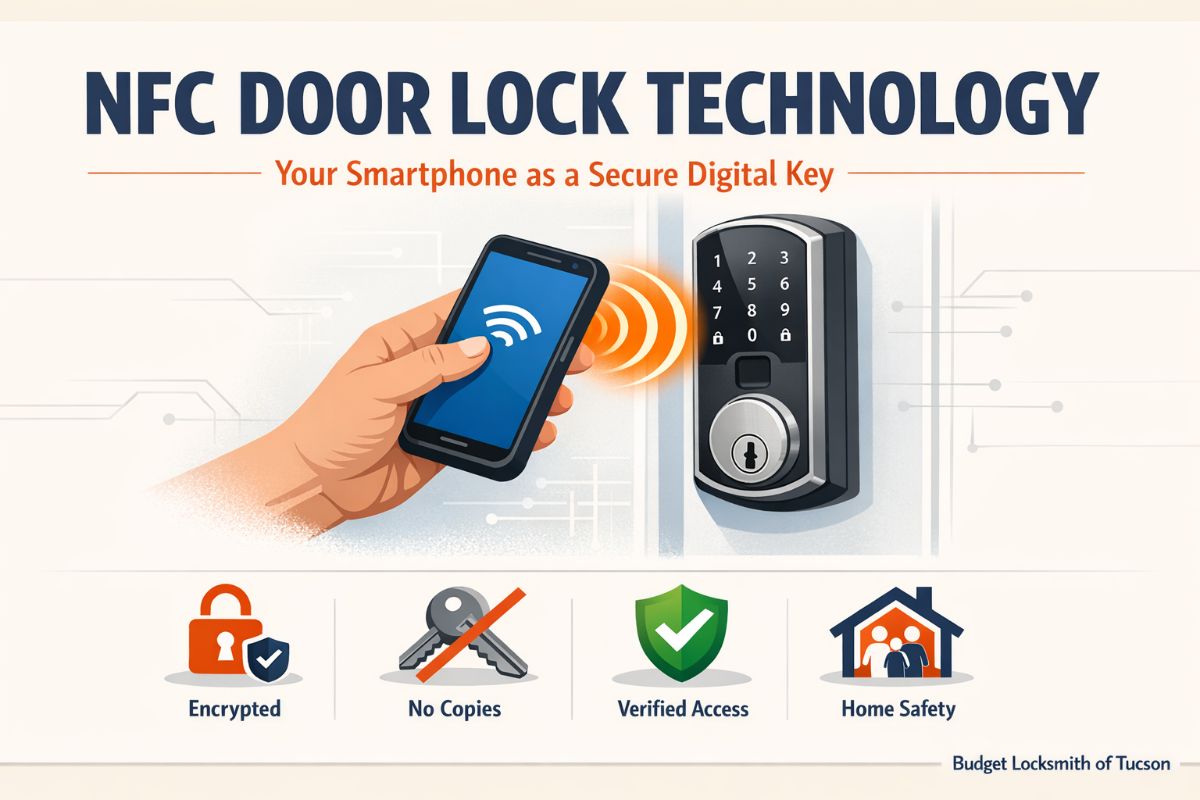
NFC stands for Near Field Communication — the same short-range wireless standard behind tap-to-pay at the grocery store. An NFC door lock reads an encrypted credential stored on your smartphone when the device is held within roughly an inch or two of the reader. Because the signal only travels a short distance, it cannot be intercepted from across the yard the way some broadcast signals can. The NFC Forum, the body that maintains the global standard, built the protocol around secure, close-proximity exchanges.
Unlike a basic keyless entry lock, an NFC system ties access to a credential that can be issued, revoked, and logged. If you want a deeper comparison of connected hardware, our guide on Wi-Fi vs. Bluetooth locks breaks down the trade-offs.
| Feature | NFC Door Lock | Deadbolt + Key | Keypad / PIN | Bluetooth / Wi-Fi |
|---|---|---|---|---|
| Credential type | Encrypted phone tag | Cut metal key | Memorized code | App or phone signal |
| Signal range | About 1–2 inches (tap) | None | None | Several feet |
| Duplication risk | Very low | High (any hardware store) | Moderate | Low to moderate |
| Guest access control | Issue and revoke digital keys | Hand over a physical copy | Share a code | Issue and revoke in app |
| Access logging | Yes | No | Some models | Yes |
| Power outage entry | Battery backup or key override | Always works | Battery backup | Battery backup |
| Interception exposure | Minimal (short range) | Not applicable | Not applicable | Higher (broadcasts) |
| Best fit | Tap entry with access records | Simple backup setups | Shared entry points | Remote unlocking needs |
How an NFC Smartphone Key Actually Works
When you tap your phone to the reader, the lock and the device complete an encrypted handshake. The credential lives inside the phone’s secure element — an isolated chip designed to protect payment and identity data — so it is never exposed as a plain code. The lock confirms the credential is valid and releases the bolt. Nothing is constantly broadcasting your presence, which is one reason security-conscious homeowners favor the tap model over always-on connections. For properties that need this scaled across many doors, an access control system extends the same principle to entire buildings.
NFC vs. Traditional Deadbolt Security
A strong deadbolt is still the backbone of any door. NFC technology does not replace the bolt — it changes how you authorize the bolt to move. Most quality NFC locks are built on a Grade 1 or Grade 2 deadbolt body certified under ANSI/BHMA standards, maintained by the Builders Hardware Manufacturers Association, then add the smart reader on top. On the interior side, a thumbturn lock lets anyone leave without a phone or key, which matters for fire egress. The result is layered deadbolt security: the physical strength of a certified bolt combined with revocable digital credentials. If your current hardware is worn or sticking, our team handles lock repair and adjustment and full security lock upgrades. For a look at bolt strength itself, our roundup of bump-proof deadbolts is worth a read.
NFC Locks and Everyday Home Safety
Beyond the front door, NFC access reshapes daily home safety. You can issue a digital key to a house cleaner for a single visit and revoke it afterward, give each family member a unique credential, and review a log of who entered. No more wondering where a copied key ended up. Because credentials are managed in software, a lost phone does not mean a lost key — you deactivate that credential and issue a new one, with no rekeying required. Homeowners who still rely on shared physical keys often ask us about rekeying their locks as a first step before upgrading.
Pro Tip From the Field
After installing hundreds of these systems across Tucson neighborhoods, here is the lesson that saves homeowners the most grief: always keep one mechanical backup credential. Program a physical key override or a backup keypad code and store it somewhere secure and off-site. Phones get dropped, batteries drain, and a software glitch should not leave you standing on the porch. We also suggest pairing an NFC lock with a biometric or keypad option on secondary doors, so no single point of failure controls your home. And if a smart lock ever stops responding, an emergency smart lock reset restores access without damaging the hardware.
Choosing and Installing the Right NFC Lock
Not every NFC lock fits every door. Door thickness, backset, strike alignment, and the condition of the frame all affect how well the bolt seats. A skilled professional locksmith evaluates these factors before recommending hardware, which prevents the misalignment that causes premature wear. Our residential locksmith team handles smart lock installation for homes and businesses alike — confirming the deadbolt grade, weatherproofing the reader against Arizona heat, and dialing in proper door lock alignment. For a broader overview of connected hardware, our guide to smart lock features and practical tips is a useful starting point.
Frequently Asked Questions
Is NFC door lock technology safe from hacking?
What happens to my NFC lock during a power outage?
Can I still use a physical key with an NFC lock?
Do NFC locks work with both iPhone and Android?
Can a professional locksmith install an NFC lock on my existing door?
How is an NFC lock different from a Bluetooth or Wi-Fi smart lock?
Bringing NFC Access to Your Tucson Home — Securely
NFC door lock technology gives you encrypted, revocable, tap-to-enter access while keeping the proven strength of a certified deadbolt underneath. The technology rewards thoughtful setup — the right hardware, correct alignment, and a sensible backup plan — and that is where hands-on expertise separates a lock that frustrates from one that protects. If you are weighing an upgrade, our certified Tucson locksmiths can walk your doors with you and recommend a system that matches how your household lives. Request a consultation or a full home security audit and upgrade, and find us on our Google Maps listing to see why Tucson families trust Budget Locksmith of Tucson. Reach out to our team and let a professional help you choose the NFC door lock technology that fits your home.